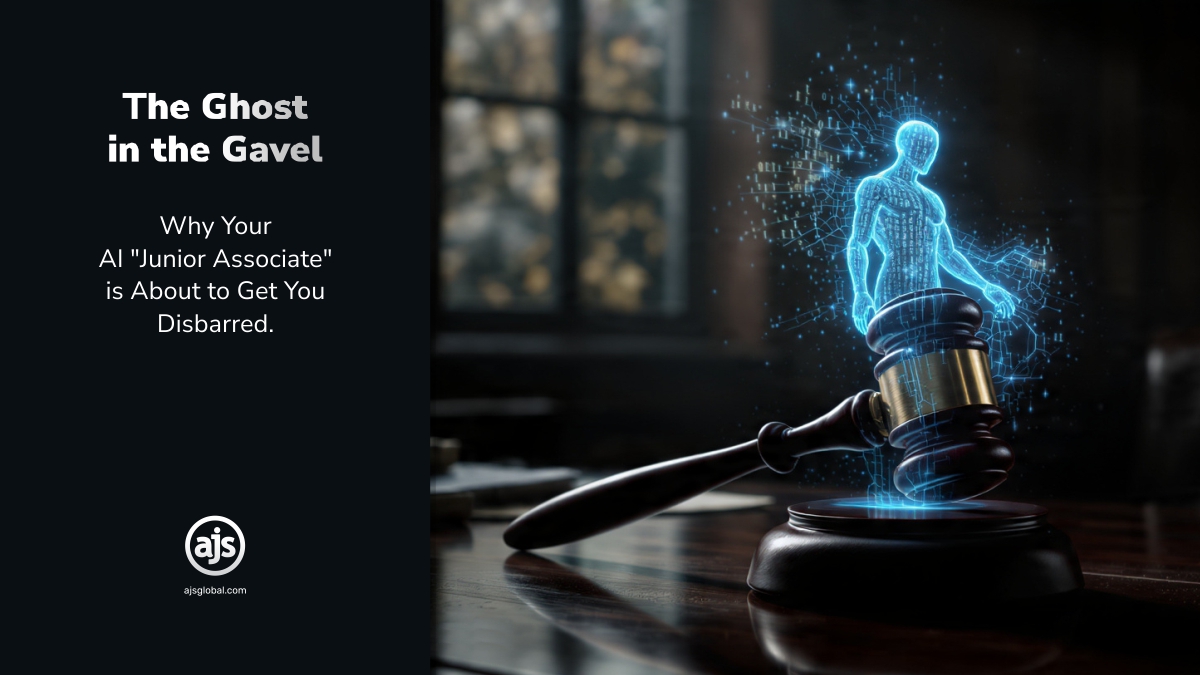
Why Your AI “Junior Associate” is About to Get You Disbarred …
Forget the “future of law” – we are currently neck-deep in a digital swamp where the difference between a winning brief and a disbarment hearing is a single, unverified hallucination. Read that again.
If you’ve been treating ChatGPT or “Claude” like a tireless junior associate who doesn’t bill for overtime or leave passive-aggressive sticky notes in the communal fridge, I have some deeply inconvenient news – the judiciary (both far and wide) has officially run out of patience. Following the global “Great Hallucination Wave”, where lawyers accidentally cited cases that existed only in the electric fever dreams of a GPU, the courts have finally struck back.
We have officially entered the era of the Mandatory AI Disclosure – a world of blockchain watermarking, signed certifications, and the terrifying prospect of having to actually read the cases you cite. Sorry lamb chop!
At AJS we’ve seen tech move mountains, but even we have to admit – watching an LLM try to “vibe” its way through a High Court filing is like watching a toddler perform open-heart surgery with a plastic spanner.
Entertaining for sure, but successful? Not a chance.
The American Fever Dream – “I Swear This Precedent is Real. Pinky Promise”
Let’s look at our friends in the United States, who are currently leading the charge into this brave new world of bureaucratic penance. As of early 2026, over thirty U.S. District Courts have implemented what can only be described as a “Digital Sobriety Test“.
Walk the Line Sir.
It’s called Mandatory Certification. Essentially, if you use AI to draft a filing, you must sign a document – under penalty of perjury and the potential loss of your dignity – stating that every single citation has been verified against a primary source. This came about because American judges grew tired of searching for Smith v. The State of Narnia (2024) only to find that the AI had simply “hallucinated” the legal principles into existence to satisfy a prompt.
Narnia is an all time favourite, but I digress.
In the U.S., the vibe check is now a legal requirement. If your AI-generated brief claims that the 14th Amendment was actually written by a sentient toaster (it’s entirely possible the way the world is going), you can’t just shrug and blame the algorithm. You are the “Human in the Loop”, which is a fancy way of saying you are the person whose neck is in the noose when the machine decides to improvise. Courts are even ruling that independent use of consumer AI may not be protected by privilege, meaning your late-night chats with Claude about your client’s liability might just become Exhibit A.
The South African Context – Loadshedding for the Soul
But let’s bring it back to the sunny shores of South Africa, where our legal challenges are slightly more… let’s say “traditional”. While a judge in New York is grappling with deepfake video evidence, a judge in Gauteng is often just trying to figure out if the court’s Wi-Fi will survive the 2:00 PM bout of Stage 4 loadshedding.
However, don’t let the lack of consistent electricity fool you. The South African Office of the Chief Justice is watching the global “Deepfake Epidemic” with the kind of weary scepticism usually reserved for a politician promising a clean audit. Haha!
Our courts have already seen a wave of fictional citations in cases like Mavundla v MEC: Department of Co-Operative Government and Traditional Affairs KwaZulu-Natal and Others [2025] ZAKZPHC 2, proving that South African lawyers are just as capable of being misled by a bot as anyone else.
In South Africa, we have a unique brand of “adversarial” litigation. We don’t just argue the law. We argue the very existence of the reality in which the law resides. Now, imagine introducing AI-generated “deepfake” evidence into a High Court battle over a mining tender. We’re not just talking about a filtered selfie. Nope. We’re talking about a flawlessly rendered video of a CEO “confessing” to a bribe that never happened, set against a backdrop of a restaurant that doesn’t exist. I KNEW there were no more fondue restaurants around! My waistline sighs in relief…
Our courts are already backlogged to the point where “expedited” means “see you in 2029” (if you’re lucky). If we add the requirement for Blockchain-based Watermarking to every piece of digital evidence to prove it hasn’t been altered by Generative AI, our trial dates might eventually start being scheduled for the next incarnation of the human race.
Sentient toasters might actually be a thing.
The “Deepfake” Arms Race – Enter the Blockchain
The trend of 2026 is Evidentiary Integrity. Because we can no longer trust our eyes, the courts are turning to the tech-bro’s favourite buzzword – Blockchain.
The idea is that every digital document, every voice note, and every Ring doorbell video of a neighbour stealing a DHL parcel must be “hashed” and watermarked on a ledger. This is meant to prove that your evidence hasn’t been “beautified” or “hallucinated” by a bot. Although a touch up of a hairline here and there – what’s the harm in that? We all deserve a little glow-up!
We’re seeing platforms like Custos Media Technologies in Stellenbosch pioneering forensic watermarking to protect media integrity, showing that South Africa is actually at the forefront of this digital fight.
It’s a delightful irony, isn’t it?
We are using the most convoluted technology ever invented to prove that the other most convoluted technology ever invented hasn’t lied to us. It’s a digital Mexican Standoff.
Pow wow Muchacho!
In the U.S., this is becoming a standard requirement for “Chain of Custody”. In South Africa, I suspect it will lead to a new billable hour category – “Time spent explaining to the Senior Partner what a ‘hash’ is and why we can’t just print it out.”
The Satire of the “Verified” Filing
Let’s contemplate the sheer, dark comedy of the “Verified AI Filing”. Picture a junior advocate, three litres of coffee deep, staring at a 40-page brief generated in seconds by a bot. They now have to spend fourteen hours checking every footnote against a physical book – or at least a very expensive, non-hallucinating database – to ensure that the AI didn’t decide to invent a new branch of Delict while it was “optimising” the word count.
The efficiency of AI has officially been cancelled out by the paranoia of the Bench. We have invented a tool that saves us time, only for the court to mandate a process that takes twice as long as the original task. Huh?!
It’s like buying a Ferrari and then being told by the traffic department that you have to walk in front of it with a red flag to warn the neighbours (I hope JMPD doesn’t read this).
At AJS, we believe in tech that adds value, not tech that adds billable hours of manual verification. But until the machines stop lying, the “Verified Filing” is your new best friend. Or your worst nightmare. Probably both. Scratch that. Definitely both.
A Renaissance for the “Human” Lawyer?
Hey, hey!
Perhaps there is a sarcastic silver lining here. For years, we’ve been told that AI would replace lawyers. “The machines are coming for your billables!” the headlines screamed.
Well, the machines arrived, they lied through their digital teeth, and now the judges want a human to hold the bag. This is the “Accountability Renaissance”. The more AI we use, the more the Court demands a “Sentient Being of Record” to take the blame. Go figure.
We are no longer just practitioners of the law. No. We have become “Hallucination Auditors”. We are the high-resolution mirrors for the machine’s ego. If you want to use the tech, you have to be the one to stand in the well of the court and explain why your “automated” evidence is claiming the defendant was on Mars at the time of the breach.
The Only Way Out is Through (and with Help)
So, where does this leave us? We are caught between the “Grind it Out” method of the 19th century and the “Glitch it Out” reality of the 21st.
Oh look, time travel IS possible!
At AJS, we strive to turn chaos into clarity. We’ve been serving the “mighty lawyers” for over 43 years, and we know that while the tech changes, the need for a cool head remains constant.
The “Get a Grip” Moment for AJS Readers
At the end of the day, the Law is – and has always been – about Trust. AI is great at patterns, but it sucks at integrity. It can write a contract, but it can’t stand before a judge and look them in the eye. Yet anyway.
If you’re teetering on the edge of “AI-enabled efficiency” and “Judicial Sanction”, it might be time to step back from the prompt bar. The view from the edge of a disbarment hearing is far less scenic than the view from a well-regulated, human-led practice.
The courts have spoken – they don’t want your bots. They want your brain (said far less ominously than a Zombie Apocalypse). And they want you to sign on the dotted line to prove it’s actually in there.
The machines aren’t going to save you from the Disclosure Mandate, but a little bit of human clarity – and the right tech partner – might just save your practice.
Because let’s be clear about one thing – the machines might be writing the law, but the humans are still the ones going to jail for it. Let’s make sure it isn’t you.
And while you’re busy with your Disclosure Mandate, if you’re in need of a service provider who has a proven track record or if you want to find out how to incorporate a new tool into your existing practice management suite – or if you simply want to get started with legal tech – feel free to get in touch with AJS. We have the right combination of systems, resources, and business partnerships to assist you with incorporating supportive legal technology into your practice. Effortlessly.
AJSis always here to help you, wherever and whenever possible!
(Sources used and to whom we owe thanks – Cliffe Dekker Hofmeyr here and here; De Rebus; Standing Order Regarding the Use of Generative Artificial Intelligence (“AI”) in Court Filings; Saiber; Disclosure and certification requirements – generative artificial intelligence; Euipo; Timestamping via Blockchain Recognized as Judicial Evidence: A New Era for Digital Intellectual Property; Mea Integrity; Lexology; Research Gate and Daily Maverick).