
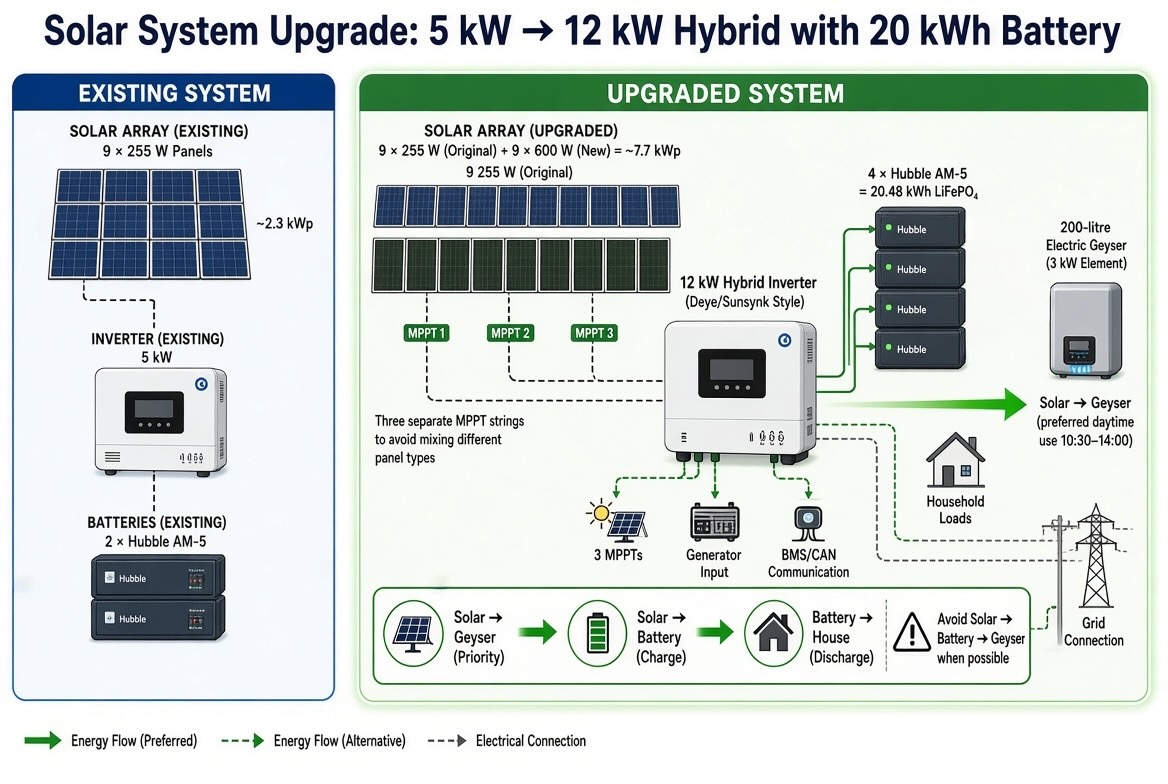
I am currently planning an upgrade to my home solar system, moving from my existing 5 kW inverter system to a 12 kW single-phase hybrid inverter with approximately 20 kWh of battery storage.
Rather than simply replacing the inverter and adding batteries, I am looking at the system as a whole — solar generation, battery storage, household loads and, importantly, how to make better use of the electricity generated during the day.
The starting point
My existing solar installation has 9 × 255 W solar panels, giving me approximately 2.3 kWp of solar generation.
The system has been doing a reasonable job of keeping the house running, but it was not designed around some of the larger loads I now want to accommodate — particularly the geyser.
I am therefore looking at a new 12 kW single-phase hybrid inverter and expanding the battery bank.
I already have two Hubble AM-5 batteries, each providing approximately 5.12 kWh of storage. I am planning to add another two.
That would give me:
4 × Hubble AM-5 = 20.48 kWh nominal battery capacity.
The AM-5 batteries are 51.2 V LiFePO₄ batteries, with a 100 A continuous charge/discharge capability. Four batteries therefore provide substantial battery-side capacity for a 12 kW inverter.
Which 12 kW inverter?
My research has narrowed the choice considerably.
The main contenders are Deye, Sunsynk, GoodWe and LuxPower, but because I already have Hubble batteries, battery/inverter compatibility and proper BMS communication are particularly important.
I don’t want an installer simply to connect the batteries and manually configure some voltage settings. I want the inverter and batteries to communicate properly using CAN/BMS communication.
Both Deye and Sunsynk have specific Hubble integration documentation for their 12 kW single-phase hybrid inverters.
The Deye 12 kW, for example, supports up to 250 A battery charge/discharge, around 19.2 kW of PV input, three MPPTs, generator input and a 24 kW peak output for up to 10 seconds.
The Sunsynk 12 kW has a very similar electrical specification and also has established Hubble integration.
GoodWe’s 12 kW ES Uniq is interesting because it can accommodate up to 24 kW of PV, but the Hubble integration is not quite as straightforwardly documented for my particular application.
LuxPower is also worth considering, although it is important to identify the exact model because there are different 12 kW LuxPower products with significantly different specifications.
For my particular retrofit, Deye 12 kW is currently looking like the most logical option, with Sunsynk a very close alternative.
Increasing the solar generation
I am considering adding 9 × 600 W ARTsolar panels.
That’s another:
5.4 kWp of solar.
Combined with the existing 2.295 kWp array, the total installed PV capacity would be approximately:
7.7 kWp
That should be a substantial improvement over the current system.
One important issue is that the old 255 W panels and new 600 W panels have different electrical characteristics. They should therefore not simply be mixed together on the same string.
The exact string configuration needs to be designed around the inverter’s MPPT voltage and current limits and the specific electrical specifications of the two panel types.
Fortunately, a 12 kW Deye has three MPPTs, giving the installer some flexibility in configuring the old and new panels.
The geyser becomes part of the solar strategy
The other part of my plan is my 200 litre, 3 kW electric geyser.
Instead of heating the geyser whenever the thermostat calls for it — potentially during expensive evening or early-morning periods — I want to make the most of the solar energy available during the middle of the day.
A 3 kW element running for four hours would consume approximately:
3 kW × 4 hours = 12 kWh
That is a significant amount of energy, but it is also a very useful controllable load. On a sunny day, I would rather use solar electricity directly to heat water than charge the batteries with that electricity and subsequently discharge the batteries to heat the geyser.
In simple terms:
Solar → geyser
is preferable to:
Solar → battery → inverter → geyser
when sufficient solar energy is available.
I am therefore looking at running the geyser predominantly during the solar-production window, perhaps around 10:30 to 14:00, rather than relying on it overnight.
Why 20 kWh of batteries?
Four AM-5 batteries provide approximately 20.48 kWh nominal storage. That gives me a considerable amount of flexibility when the sun isn’t shining.
For illustration, allowing for a conservative usable portion of the battery capacity, around 16 kWh could be available for normal use. Actual usable energy will depend on the battery’s state-of-charge limits, inverter losses, load and operating settings.
At an average household load of:
- 1 kW → roughly 16 hours
- 2 kW → roughly 8 hours
- 4 kW → roughly 4 hours
- 8 kW → roughly 2 hours
These are only illustrations, but they demonstrate why battery capacity and household consumption need to be considered together.
The proposed system
At this stage, my proposed system looks approximately like this:
- 12 kW single-phase hybrid inverter
- 4 × Hubble AM-5 — 20.48 kWh
- 9 × 600 W ARTsolar panels — 5.4 kWp
- Existing 9 × 255 W panels — 2.295 kWp
- Total PV — approximately 7.7 kWp
- 200 litre / 3 kW electric geyser
The objective isn’t simply to have a bigger inverter and more batteries.
It is to make the various components work together intelligently: use solar directly when it is available, heat the geyser during the solar window, charge the batteries with surplus solar, and use the battery bank to reduce dependence on the grid when the sun isn’t available.
The final decision will depend on the detailed solar-string design, inverter pricing, installation requirements and, importantly, getting the Hubble AM-5 BMS/CAN communication properly configured.
For me, that’s the difference between buying a collection of solar components and actually designing a solar-energy system for the way the house operates.


