Not quite. But a few products may wish to start getting their “affairs in order”.
For the past few years, I have argued that AI cannot replace serious document automation. That’s because AI is probabilistic: it produces an answer that is “probably right”, whereas document automation is deterministic: give it the same facts and it produces the same approved document, every time. And it’s widely understood that probabilistic isn’t safe for lawyers.
The evidence for that has been accumulating in public, which is a polite way of saying “in court”. Judgments dealing with invented citations and authorities that never existed have stopped being a novelty, and defective AI-generated contract work is beginning to feature rather more often than anyone selling AI drafting tools would like.
Recently some of the AI drafting solutions announced that they could search for a Word document in the firm’s own document repository, turn it into a reusable template on the fly and save the result as deterministic automation. At first glance, that sounds like the death knell for document automation software, or at least grounds for several anxious product-strategy meetings!
That said, I don’t think it is game over yet. But that does change the market far more profoundly than applications that simply add a chat box to a legal-tech product and announce that the future has arrived!
What exactly is being replaced?
If an AI product creates and runs a deterministic template, has it replaced document automation, or has it simply become another document automation product? The label matters less than the capability.
Creating a simple agreement from a precedent is one thing. Building a sophisticated, multi-document solution for banking, leasing, litigation or estate planning is another. Those solutions may contain hundreds of rules, reusable clauses, repeaters, calculations, document sets and jurisdictional variations. They also need to draw reliable data from systems such as Aderant and Elite and return the finished work to the right matter in iManage, NetDocuments or SharePoint.
AI will get there. A capable, all-purpose legal platform may eventually do everything a specialist document automation system does. But “eventually” is doing a heroic amount of work in that sentence. Complex automation is labour-intensive, deeply integrated and remarkably unglamorous. It’s a fact that document automation has always been legal tech’s ugly duckling: exceptional return on investment, very little theatre and almost no opportunity for someone to type “draft a shareholders’ agreement” on stage while the audience applauds!
The immediate threat is therefore not to the most sophisticated products. It is to the many basic products that are little more than questionnaires and merge fields wearing an expensive jacket. If AI can reproduce their capability in minutes, their reason for existing becomes difficult to defend. Personally, I welcome this shake-up in the document automation software industry. It has been a long time coming!
The real breakthrough: removing the authoring bottleneck
Years ago, one of the pioneers of legal practice-management software told me that template markup was document automation’s biggest problem. He was right.
The reason is that the software has usually been sold as a toolkit, not a finished solution. Rather like selling someone a box of plumbing parts and congratulating them on their new bathroom. Before the firm receives any value, somebody must understand the precedent, design the interview, encode the logic, test every route and maintain the result.
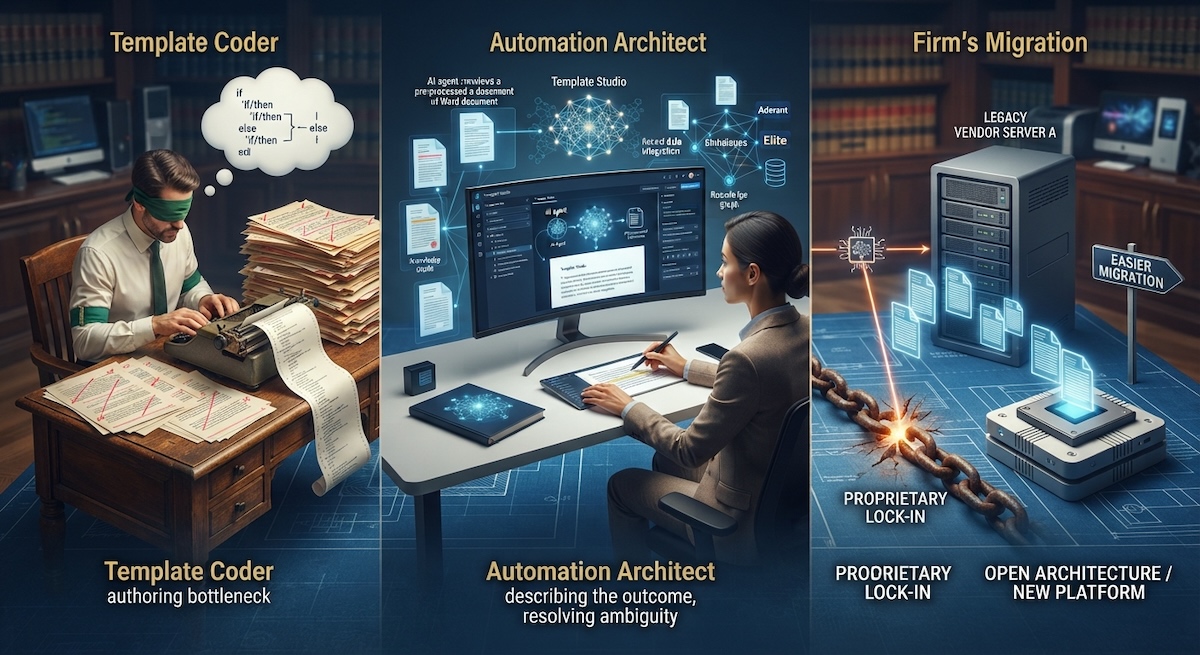
AI changes those economics. It can analyse the Word document, identify variables and conditional text, propose questions and create much of the first-pass automation. The quality will still depend on the person instructing it and reviewing the result, but the blank-page problem disappears.
That is why today’s template coders will become tomorrow’s automation architects. A better title, if nothing else. They will spend less time typing commands and more time describing the intended outcome, setting standards, resolving ambiguity and testing what AI produces. The expertise does not disappear. It moves up the value chain.
This does not kill document automation. It makes it faster to build, cheaper to maintain and easier to justify. In other words, AI may finally solve the problem that has held document automation back for forty years.
AI will also break the lock-in
There is a second consequence, and established vendors may find it less comfortable. Document automation has traditionally been extremely “sticky”. Once a firm has invested thousands of hours in a proprietary template library, changing platforms means recreating that investment. That library, not the software, is the thing the firm cannot afford to lose, and both sides have always known it.
Even when vendors increase prices by double-digit percentages, their customer support deteriorates or the product disappoints, migration is hard to justify. So the unhappy customer is forced to remain a customer, which is not quite the same thing as loyalty.
AI-assisted conversion changes that calculation. A firm can increasingly use AI to convert templates written in one product’s language to another. This is not a distant possibility; the early versions are already here. If AI can be trusted to translate the legacy code running a large law firm or a bank, a template library is not going to detain it for long.
As conversion becomes quicker and cheaper, vendors will have to retain clients through capability, service and value rather than through the cost of escape. For products built around large annual increases, indifferent support or an aggressive land-and-expand model, that may be the most disruptive effect of AI. Suddenly, the door is no longer painted on the wall.
So, which products survive?
The survivors will fall broadly into two groups. First, sophisticated platforms with deep functionality, mature integrations and the ability to handle genuinely complex work. Secondly, products with large installed libraries that continue to serve their users well enough that migration offers no compelling benefit.
The vulnerable middle is much larger: basic automation tools whose features AI can readily reproduce and acquired products that are no longer receiving the investment or attention they need but still receive regular attention from the invoicing department.
My conclusion is therefore slightly paradoxical. AI will not kill document automation. It will become part of document automation. It will remove much of the manual work involved in building templates, expose weak products and make it easier for firms to move between platforms.
That is good news for firms and, I think, for the more sophisticated document automation vendors. The market will become less about who owns the template language and more about who can deliver the strongest combination of AI, deterministic control, integration and governance.
The question is no longer whether AI replaces document automation. It is whether your document automation product becomes dramatically better because of AI, or becomes unnecessary because of it.
By Chris Pearson – XpressDox