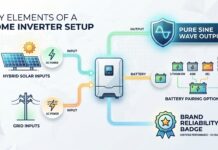
Every time I have done research online, by reading reviews, opinions and washing the selections through Ai, I get varying results and recommendations. But the solid theme always seems to come to Deye or Sunsynk with LuxPower and Solis snapping at their heals.
Before we even start looking at the inverter, there are criteria that I need (you will need) when deciding on the inverter, as I have mentioned in previous similar articles. So briefly:
Solar Panels:
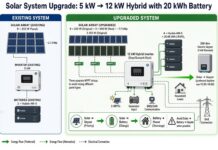
I am replacing the 9x255W Artsolar panels with new 600W Artsolar panels, which exact unit is still to be decided, but they will be either the 600W or the 620W – that we can discuss in another article. But for now it is the 600W, split between two MPPTs – a string of 5 and a string of 4.
Batteries:
I already had 2 Hubble AM5 5KVa batteries, and have just bought another 2 Hubble AM5+ 5KVa batteries to make it 4 x 5KVa – 20KVa. Hubble service centre upgraded the firmware and checked my AM5 batteries and they are set to go to connect to the new AM5+. I have also bought the Hubble CloudLink to better communication between the older and newer Hubble batteries. I must say I would have thought the AM would have communicated well with the newer AM5+, but Hubble say the interface has changed a bit and it is highly recommended to use the CloudLink – in other words, just get it.
The Inverters
Deye 12kW Single Phase Low-Voltage Hybrid (SUN-12K-SG02LP1-EU-AM3)
Offers 12kW rated output, up to 250A max charge/discharge current, 3 MPPTs, IP65 rating, and strong local availability (typically around R28,000–R35,000 unit-only). Users on Power Forum generally agree Deye inverters offer strong value, solid apps, and local data logging even without active internet, though some installers note occasional BMS handshake setup quirks that require careful protocol/cable checks.
Sunsynk 12kW Single Phase Hybrid (SUN-12.0-1PH)
Shares closely related platform DNA with Deye, featuring 12kW output, up to 240A charge/discharge current, 4ms switchover, smart/aux load support, and popular local app support (typically around R37,000–R40,000).
Luxpower 12kW Single Phase Hybrid (LXP-LB-EU 12K)
Delivers 12kW UPS backup output (11.5kW–12kW rated AC output depending on revision), up to 250A max charge/discharge current, 3 MPPTs (18kW max PV input), IP65/IP66 weatherproof enclosure, <20ms switchover, and a dedicated multi-mode port for generator, smart load, or AC coupling (typically around R28,000–R35,000).
Solis S6 Pro 12kW Single-Phase LV Hybrid (S6-EH1P12K03-NV-YD-L)
Delivers 12kW continuous output, 3 MPPTs, and IP66 protection. Users on Power Forum generally agree Solis is a strong alternative with a 10-year warranty, quick changeover, and good inductive load handling (typically around R29,000–R37,000).
What stands out to me?
Pricing:
LuxPower and Solis offer a saving of between R1000 and R4000 on the Deye and the SunSynk
Max Useable Solar Input:
Seems Deye and Solis pip the other two, but not by much.
MPPT Strings:
LuxPower is the only one that has a single set of connectors per string, the rest have a double set of connectors.
Max PV Current per MPPT:
The LuxPower with the two 15Amp strings is a concern, not because we could not work around it, but because at a later stage I may want to increase the solar banks and this would be a limitation.
UPS Switchover Time:
All are less than 10ms, except for the LuxPower at 20ms – although this probably will never be an issue, it just seems slower than the others.
Ingress Protection (IP Rating):
The Solis wins here with outside coastal resistance – but not sure my garage installation needs something too robust.
Some background information and public reviews
Deye
Built by Ningbo Deye, the exact same OEM factory that manufactures the Sunsynk 12kW. Internally, the hardware is virtually identical to Sunsynk.
Historically used the third-party Solarman app, though Deye Cloud has improved significantly. Installers note that time-of-use battery schedules are slightly less intuitive to program on screen than Sunsynk’s UI, and fan noise under heavy load is noticeable if mounted near living spaces.
SA Backup & Warranty: Supported through major national distributors (such as SegenSolar, Rubicon, and Magneto/Revov channels) with local repair centres in Johannesburg and Cape Town.
Sunsynk
The market leader in South Africa with the largest installer knowledge base. Owners praise its touchscreen interface, straightforward “System Work Mode” timer grid, and Sunsynk Connect app.
Because I am running Hubble AM-5 batteries rather than Sunsynk batteries, the warranty is 5 years (the 10-year warranty only applies when paired with Sunsynk-branded batteries).
Sunsynk operates a dedicated South African support call centre manned by engineers, which is great for remote firmware updates and installer troubleshooting. However, physical hardware warranty claims have had mixed reviews on PowerForum, during peak demand, RMA assessments and repairs have occasionally taken 3 to 6+ weeks without immediate swap-out units. Not good!
LuxPower
LXP-LB-EU 12K is a sealed, weatherproof true hybrid with a high 600V PV ceiling and an unusually high 200A AC passthrough. However, it is much less common in South Africa than Deye, Sunsynk, or Solis, and its 20ms switchover is slightly slower than the <4ms on Deye/Sunsynk (though still fast enough for most electronics).
The Luxpower monitoring app and web portal offer deep remote diagnostics and granular settings, though fewer local installers are deeply familiar with the LXP-LB-EU compared to Deye/Sunsynk.
Carries a 5-year warranty distributed via partners such as Averge Technologies and Solar Warehouse. Remote firmware support via the Luxpower server is responsive, though local parts availability for the less-common LXP-LB-EU can be slower than Deye or Solis.
Solis S6 Pro
Rapidly becoming the top alternative to Deye/Sunsynk among seasoned South African installers. Ginlong Solis is a massive tier-1 global string-inverter manufacturer, and the S6 Pro 12kW brings 40A per MPPT (future proofing for high-current 600W–700W+ panels), an IP66 sealed enclosure and dual backup ports for automated heavy-load shedding.
The SolisCloud platform and Bluetooth local commissioning app are well-regarded, though the cooling fans can spin loud when charging at high currents.
Solis maintains an official South African technical office and repair centre in Johannesburg, partnering with major distributors (like SegenSolar and Rubicon). Installer feedback highlights strong local warranty responsiveness and good availability of swap-out/service support.
What matters to me?
- They are all capable of handle the job I have for them.
- I want them to be scalable if adding more solar panels – that is not good for the LuxPower.
- I want an inverter that others know how to use and configure – so when we run into issues, there is a very good chance that people will have come across the issue before and have the solutions. Good for Deye and Sunsynk. Not too bad for Solis, but bad for LuxPower.
- Pricing does matter, otherwise I would have installed a Victron, and the winner there is LuxPower – but not by far and it varies from supplier to supplier.
- Parts are an issue if something goes wrong, and again because of the popularity of the Deye and the Sunsynk – they win.
- Communications with the batteries – Deye and Sunsynk win, the others work, with a little fiddling – but why fiddle.
- Warranty across all seem to be 5 years, but Deye if you register with them, and provide the connectivity information with the Hubble batteries, you may qualify for the 10 years. Not confirmed.
- Product backup and support is very important, the slow response from Sunsynk agents in South Africa is a big issue for me.
So depending on availability and pricing, this is the order in which I rate these inverters, in my very limited opinion.
- Deye
- Sunsynk
- Solis
- LuxPower.
Now I am ready….ish to go shopping for what I can find – I will let you know where I get it and the price.