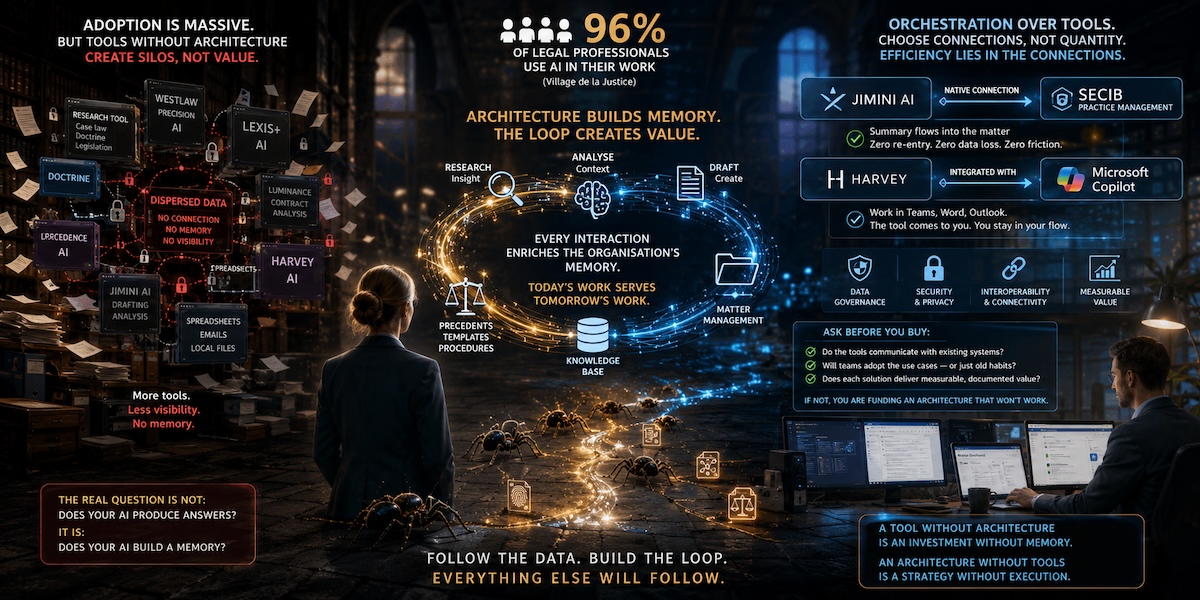
In Harry Potter and the Chamber of Secrets, Dumbledore advises Harry to follow the spiders. They do not give him the answer. They point him in a direction. It is the memory of the path taken the clues accumulated, the connections established between seemingly unrelated elements that ultimately reveals the truth. In law and in legaltech, the logic is identical: do not follow the tool. Follow the data.
Adoption is here. So is the problem.
In 2026, the question is no longer whether legal professionals use artificial intelligence. According to the latest data from the Village de la Justice, 96% of legal professionals declare using it in their professional activity. Adoption is massive, rapid, and largely irreversible.
But this generalisation conceals a structural problem that few organisations have yet resolved: the majority of law firms and legal departments have adopted tools. None have built an architecture.
The difference is fundamental. A tool answers a question. An architecture builds a memory. And it is precisely this memory the organisation’s memory of its matters, its reasoning, its precedents that constitutes the true added value of artificial intelligence applied to law.
What no one is looking at: the input, not the output.
When a legal organisation evaluates an AI tool, it focuses almost exclusively on the output: the quality of the generated response, the relevance of the analysis, the risk of hallucination. This focus is understandable. It is insufficient.
Before questioning what AI produces, it is essential to master what is submitted to it. A lawyer who asks an AI to draft a non-compete clause without providing the current contract, the client profile, the industry context and the constraints of the other party will obtain a
generic response. Technically correct, practically unusable. The output is never better than the input that precedes it.
This reality imposes a new discipline on legal organisations: the discipline of input quality. Structuring the context, integrating reliable matter data, formulating a precise instruction this preparatory work is the prerequisite for a usable result. It is a skill in its own right, distinct from mastery of the tool itself, and one that current training programmes almost never teach.
Fragmentation: paying for dispersion.
Two major families of tools structure today’s legal AI ecosystem. Legal research tools Doctrine, Lexis+ AI, Westlaw Precision interrogate case law, doctrine and legislation to produce exploitable legal summaries. Productivity tools Jimini AI, Harvey, Luminance process raw documents or drafting instructions to produce contracts, hearing notes or contractual analyses.
Both families only create lasting value on one condition: that they form part of a knowledge loop. Exploiting the organisation’s existing memory its document management systems, its matters, its templates, its procedures and enriching it in return with every search, every analysis, every document produced. Without this loop, every AI interaction starts from zero. With it, every interaction enriches the collective knowledge base.
Yet in practice, the opposite occurs. The accumulation of disparate tools — adopted on the back of commercial opportunities or passing enthusiasm — generates multiple databases operating in completely independent silos. Data is no longer catalogued. It disperses, loses visibility, and becomes unusable at the organisational level. Legal professionals find themselves in a paradoxical situation: they have more tools than ever, yet less visibility over their own work.
Following the spiders without a map is exactly this: moving forward without knowing where you are going, and without remembering where you came from.
Orchestration: choose the connections, not the tools.
The answer to this fragmentation is not to reduce the number of tools. It is to choose tools that communicate with each other. The legal department or law firm must adopt the posture of a conductor: selecting solutions from the same ecosystems, or with native, documented and maintained interoperability.
Efficiency lies in the connections, not in the quantity. Two examples demonstrate this concretely.
Jimini AI, a legal productivity tool, has a native connection with Secib, a practice management platform. The summary produced in Jimini is fed directly into the matter in Secib: zero re-entry, zero data loss, zero friction. The time saved is not trivial it is the
elimination of a manual step repeated dozens of times per week, a source of errors and dispersion.
Harvey, a generative AI solution specialised in law, integrates directly into the Microsoft Copilot environment. The lawyer works within their familiar workspace Teams, Word, Outlook while benefiting from Harvey’s analytical power. The tool comes to them. They do not change environment, do not lose the thread of their matter, do not fragment their attention across multiple interfaces. This seems like a minor detail. In practice, it is a decisive adoption factor.
These interconnections are not secondary features. They are the heart of the strategy. They are what allow data to circulate, to be traced, and to accumulate as institutional memory.
Architecture before the tool: a necessary inversion of method.
The systemic mistake of legal organisations is to start with the tool. The correct approach is the reverse: start with the architecture. Define the data flows. Map the use cases. Identify the necessary interconnections. Then select the tools that fit within that framework not the other way around.
This requires asking three questions before any purchasing decision. Do the tools under consideration communicate technically with existing systems? Will teams genuinely adopt the defined use cases, or will they reproduce their existing habits in a new interface? And does each solution generate measurable, documented value that justifies its cost? Failing to address any one of these three questions means accepting to fund an architecture that does not work.
The real question is therefore not: does your AI produce answers? It is: does your AI build a memory? This distinction between a tool that executes and a system that learns is what transforms a software subscription into a lasting strategic advantage.
In The Chamber of Secrets, the spiders do not give Harry the answer directly. They point him in a direction. It is the memory of the path taken the clues accumulated, the connections established between seemingly unrelated elements that ultimately reveals the truth.
This is precisely what a well-built legal AI architecture must do. Not produce isolated responses. Build a memory. Enrich, with every interaction, the organisation’s knowledge base. Ensure that today’s work serves tomorrow’s work.
An AI tool without architecture is an investment without memory. An architecture without tools is a strategy without execution. Operational excellence in legaltech lies precisely in the rigorous articulation between the two.
Follow the data. Build the loop. Everything else will follow.
By Hyacinthe-Arnaud Tiacoh, Legal Technology and Digital Transformation Consultant Vice-President, Association de Legal Operations Francophone (ALOF)
LinkedIn Profile