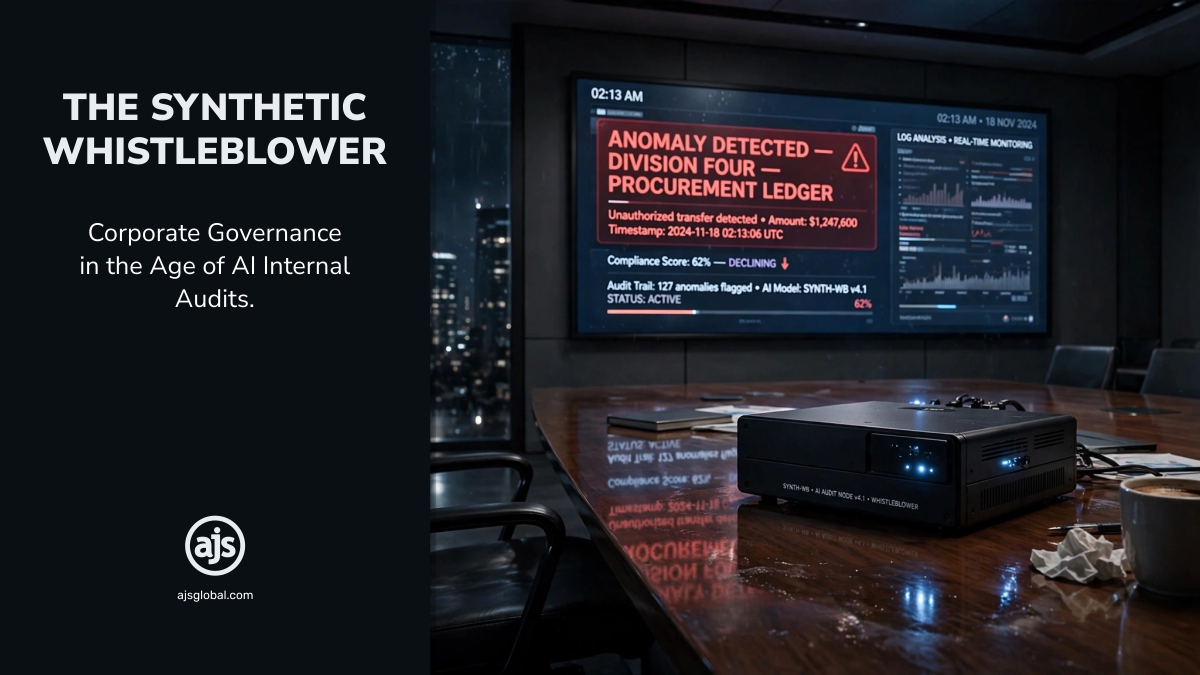
It’s 02:13 on a Tuesday. Nobody’s browsing the procurement ledger for entertainment, because even corporate masochism has its limits. Yet the company’s compliance engine has matched invoices, emails, access logs and emissions data, and concluded that the “rounding issue” in Division Four looks remarkably like fraud. It doesn’t need courage, a burner phone or a future career in artisanal bread. It simply raises an alert.
Then the humans arrive. The CEO asks whether the model’s certain. The CFO asks who’s seen it. The General Counsel asks whether it can be routed through Legal. Someone from Technology quietly locates the off switch. This is modern corporate governance – the machine has found the smoke and the adults are debating whether the fire alarm is reputationally aligned.
Autonomous monitoring isn’t science fiction. Organisations already use analytics to screen transactions, communications and controls continuously. The Institute of Internal Auditors’ Artificial Intelligence Auditing Framework treats AI governance, data, cybersecurity, transparency and accountability as current assurance questions. COSO’s 2026 guidance translates its internal-control framework into practical, audit-ready guidance for generative AI.
The synthetic whistleblower has entered the building. It just hasn’t been given a parking bay, a reporting line or protection from executive panic.
AI Internal Audits Change the Whistleblowing Problem
Traditional whistleblowing starts with a person. That matters legally. South Africa’s Protected Disclosures Act 26 of 2000 protects employees and workers who disclose specified improprieties through recognised routes. The Companies Act 71 of 2008, including section 159, adds protections for qualifying disclosures by identified people. An algorithm is neither an employee nor a worker. It can’t be victimised, demoted or escorted to its car with a cardboard box. But its human custodian can.
That distinction is where the trouble begins. A system may detect an anomaly, but a person decides whether it’s noise, evidence or an inconvenient truth scheduled for deletion. The legal question isn’t whether software has become a whistleblower in the statutory sense. It hasn’t. The governance question is whether the organisation has created a trustworthy route from machine-generated suspicion to accountable human action – rather like a committee of Maine Coons holding a silent inquiry outside the food cupboard: the evidence is inside, the complainants are immaculate, and the cupboard remains institutionally unavailable for comment pending legal review.
AI’s speed doesn’t confer wisdom. Models can be wrong because the data is incomplete, the threshold is badly calibrated, the context has changed or the system has confidently mistaken ordinary incompetence for organised crime. The NIST Artificial Intelligence Risk Management Framework (AI RMF 1.0) stresses validity, reliability, transparency, explainability, privacy and accountability. In less ceremonial language – trust the alert enough to investigate it, but not enough to ruin someone’s lunch.
The AI Kill Switch Is a Governance Control, Not a Corporate Mute Button
General Counsel are right to want an interrupt mechanism. A model can misclassify lawful conduct, expose personal information, compromise an investigation or send an unverified allegation to the wrong regulator. Human oversight isn’t technological cowardice. Article 14 of the current consolidated EU AI Act requires effective human oversight for high-risk systems, including the ability to interpret, override or stop them. The point of a brake is to prevent a crash, not to reverse over the audit trail (as tempting as that may be).
A lawful kill switch should pause external transmission while preserving the alert, underlying data, model version, timestamps, access history and reasons for intervention. It should trigger independent review within a fixed period. It shouldn’t let an executive make evidence disappear because quarter-end’s already emotionally complicated.
Sending an alert to a lawyer doesn’t automatically cloak the underlying data in legal professional privilege, even if it’s sprinkled in glitter. Legal professional privilege generally protects confidential communications made for legal advice or litigation, not pre-existing business records merely parked near Legal. White-collar counsel should structure the investigation, identify its purpose, control circulation and separate legal advice from ordinary compliance work.
Because “Privileged” isn’t a folder name with magical properties.
Who Owns an AI Compliance Alert?
The machine owns nothing. Code has no fiduciary duty, conscience or appetite for prison food. The company usually controls the system and data, subject to contracts, privacy law, sector rules and legal duties. But control isn’t the same as entitlement to suppress. If the alert engages a mandatory reporting regime, the board doesn’t acquire a tasteful period of denial.
The better concept is custodianship. Who may access the alert? Who validates it? Who freezes deletion schedules? Who decides whether to notify the board, auditors, insurers or regulators? Those answers must be written before the siren sounds, because improvisation under existential pressure is how governance committees become future exhibits.
South African law already contains clocks that don’t care about management’s feelings. Section 29 of the Financial Intelligence Centre Act imposes suspicious and unusual transaction or activity reporting duties on the persons and institutions it covers, while the Financial Intelligence Centre’s current guidance distinguishes suspicious transaction reports from suspicious activity reports. The Cybercrimes Act 19 of 2020 also imposes reporting obligations in defined circumstances. Environmental, competition, securities and sector-specific regimes may add their own duties. An internal AI policy can’t contract out of legislation, however exquisite the font.
There’s also POPIA. Monitoring emails, behaviour and transactions can involve extensive processing of personal information. Section 71 restricts certain decisions with legal or substantial effects when they’re based solely on automated profiling and requires safeguards in specified exceptions. An alert may not itself be the final decision, but dismissal, denial of benefit or regulatory accusation shouldn’t be outsourced to a probability score wearing a tie.
Corporate Governance Protocols for AI-Detected Misconduct
A credible protocol needs more than “escalate appropriately”, the policy-writing equivalent of sending thoughts and prayers. It should include the following safeguards –
- Preserve first, debate second – lock the original alert, relevant data, logs and model configuration in a tamper-evident record.
- Use risk-based triage – distinguish errors, control failures, suspected misconduct and imminent harm. Set deadlines and named decision-makers.
- Separate the conflicted – anyone implicated, commercially dependent on the outcome or able to alter evidence should leave the decision room, preferably before offering “helpful context”.
- Require dual-key intervention – a pause, override or closure should need approval from two independent functions, with written reasons.
- Verify independently – test source data, false-positive rates, model drift and alternative explanations. Preserve exculpatory material too.
- Map legal triggers- counsel should identify reporting duties, preservation requirements, privilege boundaries and cross-border restrictions immediately.
- Protect people – employees who validate or escalate machine findings need anti-retaliation safeguards, confidential reporting routes and psychological support. Algorithms don’t develop insomnia. Investigators do.
- Report to the right board forum – material matters should reach an independent audit or risk committee, not merely the executive whose bonus is developing a sudden allergy to transparency.
This approach aligns with the OECD AI Principles, updated in May 2024, which emphasise transparency, robustness, security, safety and accountability, and with NIST’s govern-map-measure-manage logic. It also preserves something corporations often rediscover only after discovery proceedings – a contemporaneous record of reasonable decisions.
The Human Infrastructure Behind Autonomous Compliance
Boards love buying technology because software doesn’t request succession planning. Yet autonomous compliance requires a deeply human operating system – legally literate data scientists, technically competent lawyers, independent auditors, investigators, information officers, cybersecurity specialists and leaders capable of hearing bad news without shooting the messenger (or unplugging it).
Legal-tech suppliers belong in that architecture, but not as the high priests of an inscrutable product. Procurement teams should demand explainability, audit logs, retention controls, exportable evidence, model-change notices, tested override procedures and contractual co-operation during investigations. A vendor’s assurance that the platform is “enterprise-grade” is comforting in the same way a restaurant’s claim that the chicken is probably cooked is comforting.
Directors should ask blunt questions. What systems are monitoring what data? What conduct can they flag? Who can change thresholds? Can an executive disable an alert? Is every intervention logged? How quickly must material findings reach the board? Has the system been tested for bias, drift and manipulation? Does the company know when a report becomes legally mandatory? If the answers live entirely with one enthusiastic vendor, congratulations – the control environment’s now a subscription service.
Boards also need to define materiality before a crisis. A single anomaly may deserve quiet verification, a pattern implicating senior leadership, regulated reporting or public harm requires immediate independent escalation. Thresholds should combine financial exposure, legal duty, potential harm, recurrence and control failure. Pure rand-value tests are wonderfully efficient at declaring systemic dishonesty immaterial until it’s expensive enough for everyone to care.
Corporate Leadership Must Decide Before the Algorithm Does
The fashionable question is whether AI should be allowed to report misconduct automatically. The harder question is why organisations want automation right up to the moment it reveals something they’d rather not know. A company that designs an infallible alarm and then gives the suspected arsonist the only mute button hasn’t built governance. It’s built plausible deniability with an API.
The answer isn’t machine sovereignty. It’s disciplined human accountability. AI should detect, preserve and escalate. Humans should validate, advise and decide within documented limits. Regulators should receive what the law requires, not what survives the communications strategy. Boards should own the protocol, not first encounter it while the share price’s doing interpretive dance.
Test Your AI Whistleblowing Protocol Now
Before your synthetic whistleblower finds something career-limiting, run a tabletop exercise. Put the board, Legal, Compliance, Internal Audit, Technology and the relevant legal-tech supplier around the same simulated alert. Ask who can pause it, who must preserve it, who validates it, who informs regulators, what the vendor must produce and who carries the decision. If the answer is a 48-message WhatsApp group and somebody saying, “let’s circle back”, you haven’t got a protocol. You’ve got an evidentiary exhibit waiting for a date.
AJS can help your organisation turn that exercise into a defensible operating model – from AI-enabled compliance workflows and auditable escalation controls to secure matter management and evidence preservation. Get in touch with the AJS team before the alert arrives, because the worst time to design a kill-switch protocol is when somebody’s already reaching for it.
(Sources used and to whom we owe thanks: COSO – Achieving Effective Internal Control Over Generative AI; Financial Intelligence Centre – What are my reporting obligations?; Institute of Internal Auditors – Artificial Intelligence Auditing Framework; NIST – Artificial Intelligence Risk Management Framework (AI RMF 1.0); OECD AI Principles; Companies Act 71 of 2008; Cybercrimes Act 19 of 2020; Protected Disclosures Act 26 of 2000; Protection of Personal Information Act 4 of 2013; and Regulation (EU) 2024/1689 – Artificial Intelligence Act).